Projecting Signs: Rules, Types and Prices
A projecting sign is visible from both directions on the pavement and catches pedestrians that a flat facade sign simply cannot reach. Here is an overview of types, prices, rules and what to consider before ordering.
What is a projecting sign?
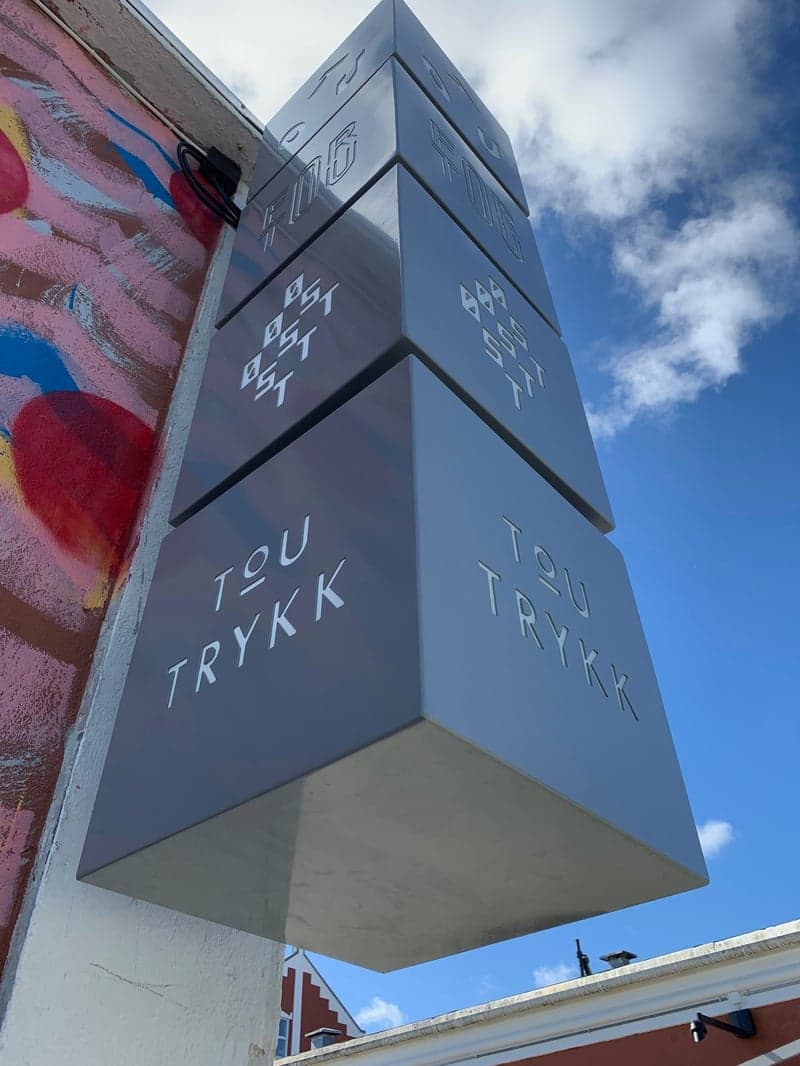
A projecting sign is a sign mounted at a right angle from a building's facade, making it visible to pedestrians and drivers moving along the street. Other names include blade sign, hanging sign and bracket sign. Unlike a flat facade sign that is only visible from directly in front, a projecting sign catches attention from both directions along the pavement.
For shops on high streets and pedestrian zones, this is often the sign type that delivers the most visibility per krone. Think of a busy street where customers walk close to the shop fronts: a sign that projects outward is what they see first, well before they are standing right at the door.
Types of projecting signs
There are several variants, and the choice depends on budget, style and whether you want illumination.
Double-sided lightbox
The most common type for modern commercial buildings. An aluminium box with an illuminated face on both sides, lit internally with LED. Provides excellent visibility around the clock and is particularly effective during dark winter months. Can be made in many shapes, from rectangular to round or custom-cut to match a logo.
Price: NOK 12,000 to 25,000 depending on size and complexity.
Blade signs and banner signs
A lighter, more affordable option. Blade signs are typically a flat panel in aluminium or dibond, mounted perpendicular to the wall via an arm or bracket. Can be printed with a logo on both sides. Well suited to cafes, hairdressers and smaller shops that want to mark their entrance without a large budget.
Price: NOK 3,000 to 8,000.
Wrought-iron and classic signs
Traditional projecting signs in wrought or forged steel with decorative elements. Common in city centres with listed or heritage buildings where the municipality sets requirements for design. Can be combined with a hanging wooden sign. Creates a craftsman-quality, premium look.
Price: NOK 5,000 to 15,000 depending on size and level of detail.
3D letter signs on an arm
Freestanding three-dimensional letters mounted on an arm that extends from the facade. A variant that combines the premium appearance of LED letters with the street visibility of a projecting sign. Works well for brands that want to stand out without using a traditional lightbox.
Price: NOK 15,000 to 30,000 depending on the number of letters and illumination.
Prices for projecting signs
Here is a combined overview of price ranges for the most common types:
| Type | Price range | Illumination |
|---|---|---|
| Blade sign / banner sign | NOK 3,000 - 8,000 | Unlit or with spotlight |
| Wrought-iron / classic | NOK 5,000 - 15,000 | Unlit or with spotlight |
| Double-sided lightbox | NOK 12,000 - 25,000 | Internal LED |
| 3D letter sign on arm | NOK 15,000 - 30,000 | LED front- or back-lit |
All prices ex. VAT. Includes design and standard installation. Building permit fees are additional. Read more about facade sign costs for a complete price overview of all sign types.
Rules and requirements for projecting signs
Projecting signs are subject to stricter regulation than flat facade signs. The reason is straightforward: the sign extends over the pavement or public space, affecting both safety and the visual environment.
A building permit is almost always required
Because projecting signs extend from the facade, they fall outside the exemptions in the building regulations that apply to flat wall signs. In practice, this means you will almost always need a building permit. A standard sign application typically costs NOK 3,000 to 10,000 in municipal fees and takes around 3 weeks to process.
Minimum clearance above the pavement
To ensure pedestrians can safely pass beneath the sign, most municipalities require a minimum clearance of 2.5 metres from the bottom of the sign to ground level. Some municipalities operate with 2.7 metres. Check the rules in your local area.
Maximum projection from the facade
Municipalities typically set a limit of 1 to 1.5 metres for how far a projecting sign can extend from the facade. In narrow streets and central areas the limit may be lower.
Municipal restrictions
Several cities have specific rules for projecting signs:
- Stavanger has strict signage bylaws in the city centre. Lightboxes are restricted, and the municipality prefers traditional sign types on heritage buildings.
- Sandnes permits only one business sign per facade plus one information sign. Lightboxes are not permitted in the town centre.
- Oslo has a legally binding signage and advertising plan with specific guidelines for projecting signs across different zones.
- Bergen assesses sign applications against the municipal plan, and projecting signs in the city centre are subject to strict scrutiny.
Always arrange a pre-application meeting with your municipality's planning department. This is free in most municipalities and gives you clarity on what is permitted.
Materials
The choice of material affects durability, weight and price.
Aluminium is the most common material for modern projecting signs. Lightweight, rust-free and easy to shape. Used in lightboxes, blade signs and brackets.
Acrylic is used as the light face in lightboxes. Available in white (for a diffused glow) or in brand colours. Holds up well in most weather, but can yellow after many years of direct sunlight.
Steel and stainless steel give a sturdy, industrial look. Heavier than aluminium but more durable. Used in brackets and arms for heavy signs.
Wood is used in classic and traditional projecting signs. Requires more maintenance (painting or staining every 3 to 5 years), but gives a warm, handcrafted character that suits historic urban environments.
Illumination
An illuminated projecting sign is visible around the clock, which matters particularly in Norway where winter brings very short days.
Internal LED lighting. Used in double-sided lightboxes. Provides even light across the entire sign face. Energy efficient (60-80% lower power consumption than fluorescent tubes) and rated for 50,000 to 100,000 hours.
LED edge lighting. Creates a glowing border around the sign. Can be used on blade signs and 3D letters. Draws attention without overpowering the facade.
Spotlighting (unlit sign with external light source). A cost-effective solution where an external lamp illuminates the sign. Suitable for wrought-iron signs and other traditional types where internal illumination is not desired.
Installation and maintenance
Installing a projecting sign requires fixing points that can handle wind and snow loads. The sign acts as a wind catch, and the fixings must be sized accordingly.
Wall mounting. The most common method. Brackets are bolted through the facade into the structural frame. The facade material determines which fixings are needed: concrete and steel are straightforward, while lightweight concrete block and insulated sandwich panels require specialist solutions.
Maintenance. LED-illuminated signs need minimal upkeep. An annual clean of the sign faces and a visual check of the fixings is enough for most installations. Wooden signs need surface treatment every 3 to 5 years.
Electrical connection. Illuminated projecting signs require an electrical connection. The cable is typically routed through the facade and connected to a dedicated circuit. This work must be carried out by a licensed electrician.
Order a projecting sign from Show Off
Show Off designs, produces and installs projecting signs from our workshop in Sandnes. We handle the entire process: site survey, design, building permit application, production and installation. You do not need to coordinate between multiple suppliers.
Send us an enquiry with a photo of the facade and a description of what you are looking for. You will receive a no-obligation quote within a couple of days.
See examples of signs we have made or read more about sign prices. Running a shop? You may also find our shop signs guide useful.
Read also: Building permit for facade signs | Sign maker in Stavanger and Sandnes
Why Choose Show Off for Signage?
A strong signage project combines design, material knowledge, production, and installation. At Show Off, we help clients from the first evaluation to the finished installation, with production in Sandnes and a clear focus on visibility, durability, and practical use in Norwegian conditions.
That makes it easier to make the right decisions early, whether you need a facade sign, illuminated letters, wayfinding, or a more local signage solution.
Next Step
Need help choosing the right sign type, size, or budget? See our signage services or contact us for a no-obligation review.
More signage articles
More expert articles on signage, facades and installation:

Jan Tore Råen
Partner and signage advisor
Jan Tore works with signage, facade signs, wayfinding, and visual branding for businesses across Norway. He advises on materials, visibility, permit requirements, and installation.
Need help deciding?
Relevant projects
See real client cases and deliveries closely related to the topic of this guide.
Stay updated
Subscribe to our newsletter for tips on branding, wrapping and more.