
Pylons and Freestanding Signs: Types, Prices and Tips
A pylon makes your business visible from the road, even if the building sits far from the carriageway. Here we explain which types are available, what they cost and what to consider before ordering.
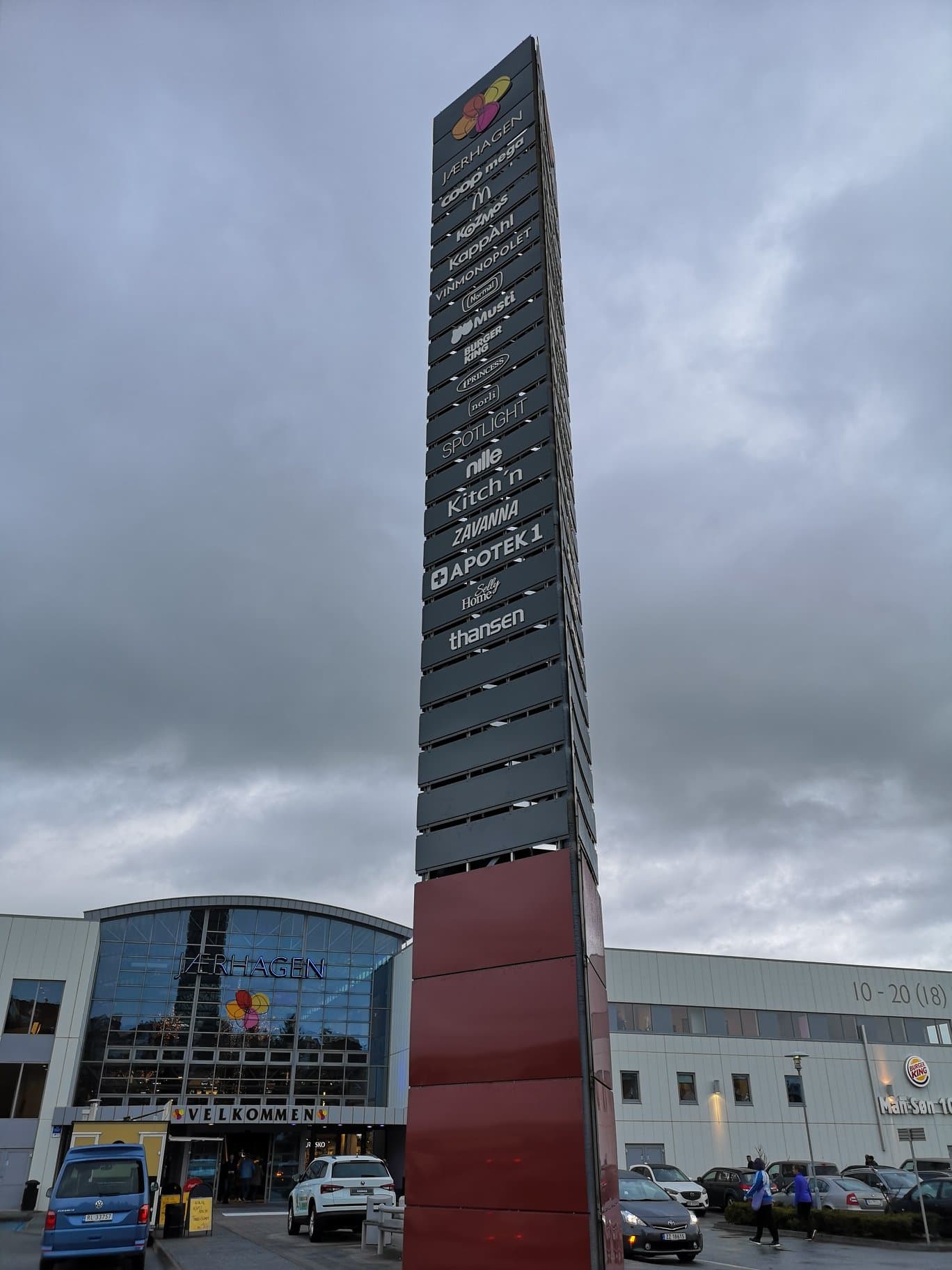
What is a pylon?
A pylon is a freestanding sign mounted in the ground, typically at entrances, car parks or alongside roads. Pylons differ from facade signs in that they are not attached to a building but stand on their own foundation. Heights range from 1.5 metres for simple information pylons to over 6 metres for large multi-tenant structures.
For businesses set back from the road, located in business parks or in buildings with no usable facade space, a pylon is often the only way to be seen. Think of all the business parks along the E39 or rv. 44 in Rogaland: without pylons at the entrance, you would never know who is based there.
Types of pylons
Simple information pylon
The most affordable option. A sign panel in aluminium or dibond mounted on a post or frame. Usually unlit, 1-2 metres tall. Suitable for low-traffic businesses that simply need a visible name at the entrance.
Illuminated pylon with LED
Same principle as the information pylon, but with internal or external LED lighting. The sign face lights up in the dark and is visible around the clock. In Rogaland, where the dark season stretches from October to March, lighting is almost a necessity for businesses that want visibility after four in the afternoon.
Large multi-tenant pylon
Tall pylons (4-6 metres) with space for several businesses. Each company gets its own panel with logo. Common in business parks, shopping centres and office buildings with multiple tenants. Costs are often shared between the businesses. These pylons typically feature LED lighting and require solid foundations.
Totem and monolith
A monolithic structure where the sign face and base are continuous, with no visible post. Gives a more premium and modern appearance. Often used by car dealerships, hotels and brands with strict visual guidelines. Available in everything from brushed steel to powder-coated aluminium.
Wayfinding pylon
Shorter pylons (1-1.5 metres) placed within a site to guide visitors to the right building or entrance. Business parks with several buildings often use a set of wayfinding pylons in addition to a large pylon at the main entrance.
Pylon prices
The prices below are indicative and include design, production and installation. Foundation and building permit are additional costs.
| Type of pylon | Height | Typical price |
|---|---|---|
| Simple information pylon | 1-2 m | NOK 30,000 - 50,000 |
| Illuminated pylon with LED | 2-4 m | NOK 50,000 - 80,000 |
| Large multi-tenant pylon | 4-6 m | NOK 80,000 - 120,000+ |
| Totem/monolith | 1.5-3 m | NOK 40,000 - 70,000 |
| Wayfinding pylon | 1-1.5 m | NOK 15,000 - 30,000 |
All prices excl. VAT. For a complete quote we need to know the desired size, number of sign panels, whether you want lighting and where the pylon will be placed. Send us an enquiry for a no-obligation site visit.
What affects the price?
Height. The taller the pylon, the more material and the stronger the structure required. A 5-metre pylon needs entirely different steel profiles than a 2-metre one.
Lighting. LED lighting adds NOK 15,000-25,000 to the price, depending on the number of panels and size. But the visibility after dark makes it an investment most businesses do not regret.
Number of panels. A multi-tenant pylon with six panels naturally costs more than one with two. Each panel means more material, more design work and more labour for logo installation.
Foundation. All pylons need a foundation. The cost depends on ground conditions and the size of the pylon. More on this below.
Building permit. Pylons almost always require a building permit, and the process costs NOK 12,000-20,000. This is a fixed cost not affected by the pylon price.
Foundation and installation
A pylon is a structure that must withstand westerly winds and stand firm for years. The foundation is critical.
Concrete foundation
All pylons need a concrete foundation that anchors the structure in the ground. The foundation is dimensioned according to the pylon's height, weight and wind load.
| Foundation type | Typical price |
|---|---|
| Simple foundation (1 mast) | NOK 13,308 |
| Double foundation (2 masts) | NOK 26,616 |
Excavation
Before the foundation can be poured, digging is required. The cost varies with ground conditions. Rock requires chipping or drilling, while soil and gravel are simpler. Allow NOK 5,000-15,000 for excavation depending on conditions.
Electrician
Illuminated pylons require a power connection. An electrician must run cable from the nearest electrical point and connect it to the pylon's LED system. This cost depends on the distance to the power source and is typically NOK 5,000-15,000.
Installation
Show Off installs pylons with our own fitters and equipment. Installation is included in the prices above. For large pylons we use a crane truck, which is also included.
Building permit for pylons
Pylons almost always require a building permit. They are freestanding structures that affect the visual environment, and the municipality must approve placement, height and design.
The application process involves:
- A site plan showing the pylon's location
- Drawings with dimensions and material specifications
- Description of lighting
- Neighbour notification where required
We assist with the entire application process. From experience, it takes 3-8 weeks from submission to approval. The cost for the application work is NOK 12,000-20,000, and you avoid having to navigate the regulations yourself.
When do you need a pylon?
Not every business needs a pylon. But for some, it is the most effective signage solution:
Businesses along main roads. Is the building 50 metres or more from the road? Then no one sees the facade sign from a car. A pylon at the entrance catches the eye.
Business parks with multiple tenants. A multi-tenant pylon at the entrance shows who is based on the site. The alternative is customers driving past without finding the right place.
Car dealerships and workshops. The automotive industry is a major user of pylons. A tall, illuminated pylon with a brand logo is standard for most dealerships.
Shopping centres and retail areas. Large multi-tenant pylons along the road tell motorists which shops are inside the centre.
Hotels and conference venues. A pylon at the turnoff helps guests find their way, especially in the dark.
Businesses with a facade directly facing the street and good visibility from the pavement can usually manage well with a facade sign.
Materials and durability
Pylons are built in aluminium or steel, with sign faces in aluminium, acrylic or dibond. The structure is powder-coated to withstand weather and wind. A well-built pylon lasts 15-20 years with minimal maintenance. LED lighting has a lifespan of 50,000 to 100,000 hours.
We recommend choosing materials suited to the climate where the pylon will stand. Along the Rogaland coast, exposure to wind and salt is greater than inland, which affects the choice of surface treatment.
Book a site visit
We come out and assess the location, take measurements and give you a concrete quote. Site visits in Stavanger, Sandnes and the surrounding area are free of charge.
Contact us for a site visit or call Jan Tore on 919 22 332.
See also: How much does a facade sign cost? | Building permit for signs | Sign maker in Stavanger and Sandnes | Sign services | Construction site signs
Why Choose Show Off for Signage?
A strong signage project combines design, material knowledge, production, and installation. At Show Off, we help clients from the first evaluation to the finished installation, with production in Sandnes and a clear focus on visibility, durability, and practical use in Norwegian conditions.
That makes it easier to make the right decisions early, whether you need a facade sign, illuminated letters, wayfinding, or a more local signage solution.
Next Step
Need help choosing the right sign type, size, or budget? See our signage services or contact us for a no-obligation review.
More signage articles
More expert articles on signage, facades and installation:

Jan Tore Råen
Partner and signage advisor
Jan Tore works with signage, facade signs, wayfinding, and visual branding for businesses across Norway. He advises on materials, visibility, permit requirements, and installation.
Relevant projects
See real client cases and deliveries closely related to the topic of this guide.
Stay updated
Subscribe to our newsletter for tips on branding, wrapping and more.