HSE Signs on Construction Sites: Requirements, Regulations and Checklist
Missing or incorrect signage on construction sites can lead to enforcement fines from the Norwegian Labour Inspection Authority. Here you get an overview of which HSE signs are legally required, what the regulations say about colours and placement, and a checklist you can use on your site.
What are HSE signs?
HSE signs are mandatory signs that warn about hazards, requirements, and emergency exits at workplaces and construction sites. They follow the ISO 7010 standard.
Which HSE signs are required on construction sites?
Norwegian law requires all construction sites to display safety signs showing mandatory actions, prohibitions, hazards and emergency information. The requirements come from several regulations, and both the employer and the building client are responsible for correct and up-to-date signage.
Let's walk through the regulations, sign categories and what you actually need.
The regulatory framework
Three key pieces of legislation form the basis for HSE signage on Norwegian construction sites:
The Working Environment Act (Arbeidsmiljøloven, Chapter 4) requires the working environment to be fully satisfactory. This includes the employer's duty to sign hazardous areas, escape routes and PPE requirements.
The Workplace Regulations (Arbeidsplassforskriften, Chapter 5) contain the specific rules for safety signage. Sections 5-1 through 5-7 define which sign types must be used, how they should look, and where to place them. Section 5-12 requires permanent marking wherever workers may be exposed to danger.
The Building Client Regulations (Byggherreforskriften, Section 10) require the advance notification to the Labour Inspection Authority to be posted visibly on the construction site. The regulations also require an SHA plan (safety, health and working environment plan) that describes risks and measures, including signage requirements.
Additionally, the Regulations on the Performance of Work (Chapter 22) require employers to provide training and instruction on what the safety signs mean and what behaviour they demand from workers.
Five categories of safety signs
Section 5-7 of the Workplace Regulations defines five main categories of safety signs. Each category has specific colours and shapes following the international standard NS-EN ISO 7010.
| Category | Shape | Colours | Examples |
|---|---|---|---|
| Prohibition signs | Round | Black symbol, white background, red border and diagonal line (red covers at least 35%) | No entry, no smoking, no open flames |
| Warning signs | Triangle | Black symbol, yellow background, black border (yellow covers at least 50%) | Fall hazard, electrical hazard, crushing hazard, suspended load |
| Mandatory signs | Round | White symbol, blue background (blue covers at least 50%) | Hard hat required, safety shoes required, high-vis vest required, safety glasses required |
| Emergency signs | Rectangular | White symbol, green background (green covers at least 50%) | Emergency exit, escape route, assembly point, first aid equipment |
| Fire safety signs | Rectangular | White symbol, red background (red covers at least 50%) | Fire extinguisher, fire hose, fire alarm |
The colour codes are not arbitrary. They are standardised so that everyone understands the message regardless of language. A Polish carpenter and a Norwegian electrician should both instantly recognise a blue circular sign as a mandatory instruction.
What do you need? Complete checklist
Here is an overview of the HSE signs typically required on a construction site. Which signs you need depends on the nature and scale of the project, but this list covers the most common requirements:
At the site entrance
- Construction site sign with mandatory and prohibited actions (combination sign)
- No entry for unauthorised persons
- Advance notification from the Labour Inspection Authority (posted visibly)
- Mandatory PPE: hard hat, safety shoes, high-vis vest, safety glasses, hearing protection
On the construction site
- Warning signs at risk zones (fall hazard, crushing hazard, electrical hazard, suspended loads)
- Mandatory signs for specific PPE in relevant zones (respiratory protection for dusty work, hearing protection in noisy areas)
- Marked traffic routes for vehicles and pedestrians
- Obstacles and dangerous locations marked with yellow/black or red/white striped markings at a 45-degree angle
Fire and emergency situations
- Fire extinguishers marked with red fire safety signs
- Fire hoses and other fire equipment clearly marked
- Escape routes and emergency exits with green emergency signs
- Assembly point for evacuation
First aid
- First aid equipment marked with a green cross
- Defibrillator (AED) marked with signage
- Emergency telephone number displayed visually
Chemicals and hazardous substances
- Storage areas for hazardous substances marked with warning signs
- Pipelines marked with flow direction arrows and colour codes
Material and placement requirements
Safety signs on a construction site must withstand tough conditions. The Workplace Regulations set the following requirements:
Material: Signs shall be made from material suitable for the environment they will be placed in. On a construction site, this means weather-resistant and impact-resistant materials. PVC banner, aluminium and laminated plastic are common choices.
Size: Signs must be large enough to be seen and understood at the distance from which they need to be effective. A small sign that cannot be read from five metres away does not meet the requirement.
Lighting: Where natural light is poor, luminescent colours, reflective material or artificial lighting shall be used. Emergency signs must always have luminescent properties so they remain visible during power failures.
Placement: Signs shall be positioned so they do not create hazards or unwanted obstructions. They should be placed at eye level where possible, and never higher than 20 degrees above the horizontal line of sight.
Removal: When the hazard or situation a sign refers to is no longer present, the sign shall be removed. Outdated signs create confusion and undermine confidence in the remaining signage.
The advance notification: The site's most important posting
For projects lasting more than 15 working days or exceeding 250 person-days, the building client must send an advance notification to the Norwegian Labour Inspection Authority. This notification must be posted visibly on the construction site, and it is the building client's responsibility to keep it updated.
The advance notification contains information about the building client, coordinators, contractors and the scope of the project. In practice, it functions as an ID for the construction site and must be visible to everyone entering the area.
Consequences of missing signage
The Norwegian Labour Inspection Authority (Arbeidstilsynet) conducts inspections on construction sites and reacts to missing or inadequate safety signage. Reactions can include:
Orders: The Authority gives the business a deadline to rectify the deficiencies. This is the most common reaction.
Coercive fines: If orders are not complied with within the deadline, ongoing coercive fines may be imposed.
Violation fines: For serious breaches, the Authority can impose violation fines. Since 1 July 2024, the fine can amount to up to 50 times the National Insurance base amount (approximately NOK 6.2 million) or 4 percent of the company's annual turnover. In practice, fines for signage deficiencies alone are often lower, but combined with other HSE violations, the total can become substantial.
Seven out of ten violation fines from the Authority are imposed on construction and civil engineering businesses. Correct signage is one of the simplest ways to avoid problems during inspections.
How Show Off AS can help
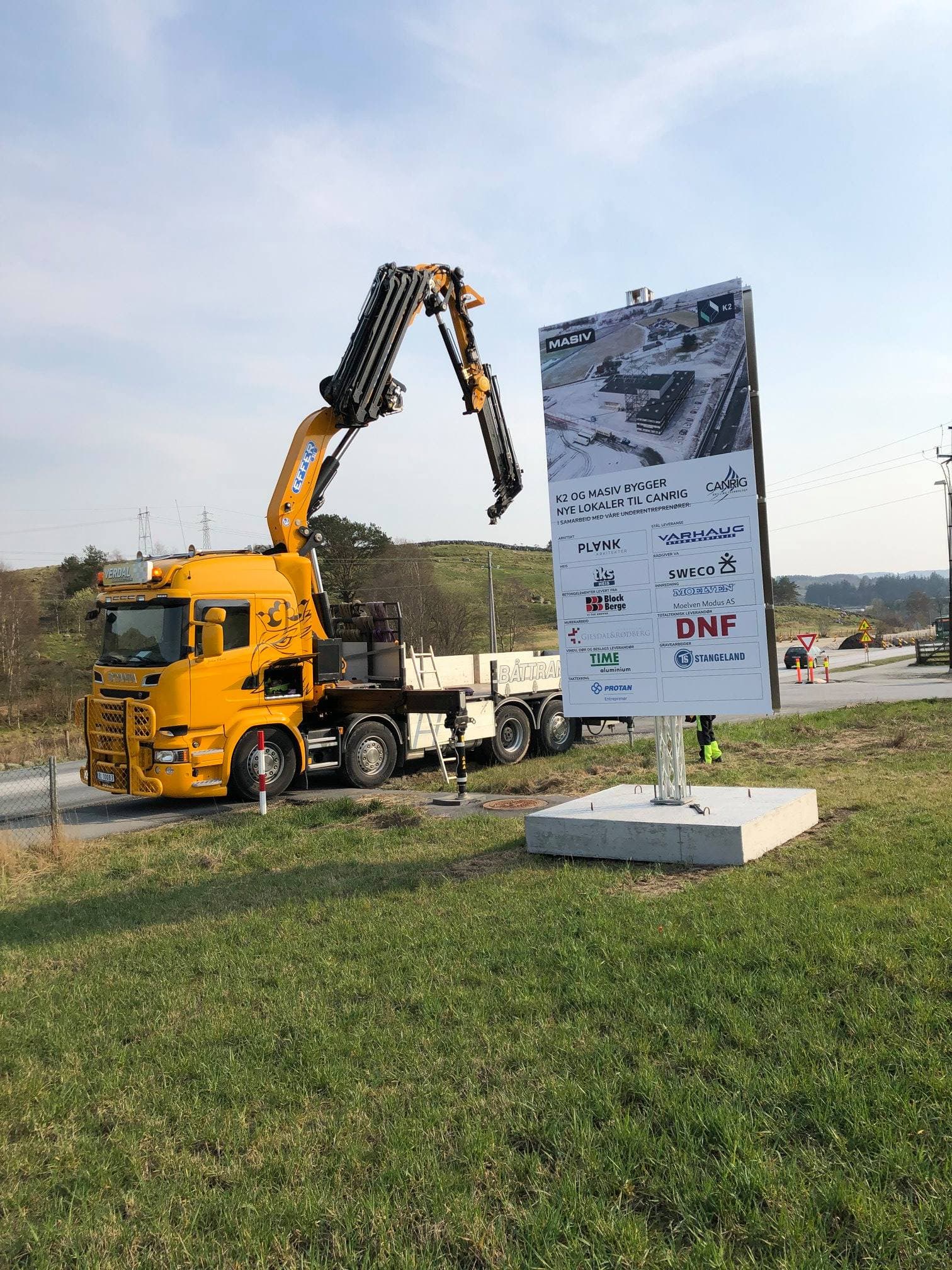
We deliver complete sign packages for construction sites across Norway. Everything from standard construction site signs with mandatory and prohibited actions, to custom information signs, project signs and SHA boards.
Our signs are produced in materials that withstand Norwegian construction site conditions: wind, rain, dust and mechanical wear. We use ISO 7010-approved symbols and correct colours in accordance with the Workplace Regulations.
What we offer:
- Standardised HSE construction site signs with all mandatory and prohibition symbols
- Project signs with developer, contractor and project information
- Warning and hazard signs for specific risk zones
- Fire safety and emergency signs
- First aid signs
- Fencing signs and facade banners
We can put together a complete sign package tailored to your project, so you can be confident the site meets all requirements from day one.
See our construction site sign services or contact us for a no-obligation quote. You can also read more about facade signage and other signage solutions we offer. Need a facade sign for your commercial building? Read our guide on building permits for facade signs for rules and process.
Show Off AS is based in Sandnes and produces signs for customers throughout the Stavanger region. Read more about sign production in Stavanger and Sandnes.
Frequently asked questions
Who is responsible for HSE signage on the construction site?
The employer has the primary responsibility for safety signage at the workplace, according to the Working Environment Act and the Workplace Regulations. The building client also has responsibility for posting the advance notification and ensuring the SHA plan includes signage requirements. In practice, day-to-day responsibility is often delegated to the main contractor or SHA coordinator.
Is there a standard for how HSE signs should look?
Yes. NS-EN ISO 7010 is the applicable standard for safety signs in Norway and Europe. The standard defines colours, shapes and symbols for each sign category. Signs following this standard are recognisable regardless of language, which is important on multilingual construction sites.
How much does it cost to sign a construction site?
A standard construction site sign with mandatory and prohibited actions typically costs between NOK 2,000 and 8,000, depending on size and material. A complete sign package for a medium-sized construction site, including all necessary warning, emergency and fire signs, typically runs between NOK 10,000 and 30,000. Contact us for a quote tailored to your project.
Do signs need to be replaced during the project?
Signs that are damaged, faded or illegible must be replaced immediately. In addition, signs must be removed when the situation they refer to is no longer relevant. Good materials that withstand weather and mechanical wear reduce the need for replacement. Show Off AS produces signs in materials suited to Norwegian conditions, so they last through the entire project.
Do the same rules apply to small and large construction sites?
The basic requirements for safety signage apply to all construction sites, regardless of size. The advance notification requirement only applies to projects exceeding 15 working days or 250 person-days. But even on small projects, you must have prohibition, mandatory and warning signs where there is relevant risk. It is better to have one sign too many than one too few.
Why Choose Show Off for Signage?
A strong signage project combines design, material knowledge, production, and installation. At Show Off, we help clients from the first evaluation to the finished installation, with production in Sandnes and a clear focus on visibility, durability, and practical use in Norwegian conditions.
That makes it easier to make the right decisions early, whether you need a facade sign, illuminated letters, wayfinding, or a more local signage solution.
Next Step
Need help choosing the right sign type, size, or budget? See our signage services or contact us for a no-obligation review.
More signage articles
More expert articles on signage, facades and installation:

Show Off AS
Editorial team at Show Off
When Show Off AS is listed as the author, the content has been written and reviewed by our internal team working with branding, exhibitions, signage, wrapping, and promotional products.
Relevant projects
See real client cases and deliveries closely related to the topic of this guide.
Stay updated
Subscribe to our newsletter for tips on branding, wrapping and more.